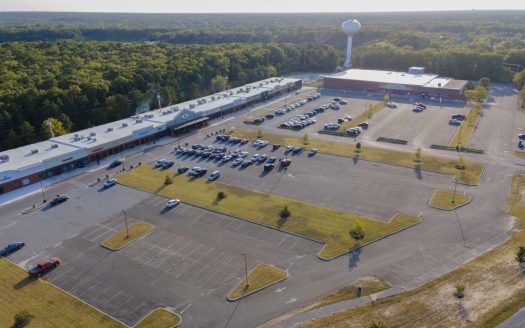
The Most Overlooked Asset on Your Property Might Be the Parking Lot
By Ma’or Hemo, Sales Associate at Vantage Commerical
Added value is parked around your property. Too much asphalt and you’re carrying dead land. Too little and you may be capping what your site can become. Either way, parking can say a lot about what commercial property is worth, sometimes as much as the building sitting on it. A hundred years of parking rules got us to where we are, and those rules are finally starting to loosen. What does that mean for owners here in New Jersey?
For most of human history, going downtown was relatively simple. You walked, rode a horse, or you took the carriage into town. The “parking lot” was a hitching post out front, and if your transport was more than two legs, maybe a stable around back. There were no zoning codes over how many horses the general store had to accommodate. The horse sorted itself out. The car did not. Karl Benz built the first practical automobile in 1885, the Duryea brothers gave America its own in 1893 when they put a gas engine on an old horse buggy in Springfield, Massachusetts, and once cars caught on, those vehicles needed to be somewhere when they weren’t moving.
The first instance of this came in 1923, when Columbus, Ohio adopted the first known off-street parking requirement, aimed at new apartment buildings. It took just 38 years from Benz’s invention to the first parking law, which is pretty quick by township response standards. The idea was reasonable enough at the time: make sure a new building brought its own parking so it wouldn’t swamp the street out front. By the 1950s, parking minimums were a staple of American planning. A store needs this many spaces per square foot. A restaurant needs that many per seat. A hundred years later, most of those rules are still on the books and in a car-dependent market like ours, it isn’t optional. Anyone who has tried to get around South Jersey without a car knows exactly how that turns out.
In other markets the rules have started to loosen. Buffalo became the first major American city to abolish parking minimums in 2017, and more than 200 cities have since eliminated them or are actively working toward it. California banned parking mandates near transit statewide, effective 2023, and in 2025 Washington State passed the broadest rollback in the country. In New Jersey, change comes township by township, through variances, redevelopment plans, and shared parking agreements. The struggle for property owners is a conservative decision body can oftentimes be unwilling to move on traditional standards.
For New Jersey owners, the path of least resistance is working with the township, optimizing that highest and best use for your property. Vantage is seeing this firsthand with a liquor store we have listed on Route 130 in Burlington County. The parcel has far more parking spaces than the business needs, providing the opportunity for pad sites. Working with the township, the new development plan calls for a three-story building with roughly 38 apartments on one side of the parking lot, allowing the store to keep operating and turns a desert of asphalt into income.
If you have more parking than you need, that asphalt may be your most valuable asset. If you have too little, there are options like a variance or shared parking agreement. At Vantage Commercial, our experience and local knowledge means we are familiar with the townships and how they operate and can help turn parking into an opportunity.